
 English
Which filaments in FDM belong to “carbon fiber materials”?
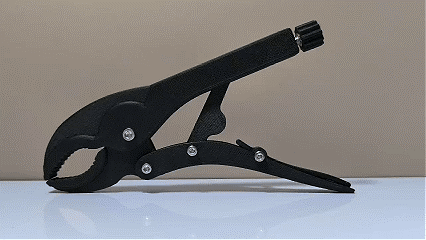
When it comes to carbon fiber filaments, many people's first reaction is:“As long as the filament name contains CF, is it carbon fiber material?”
Basically, that can be understood this way.
In FDM 3D printing,CF usually stands for Carbon Fiber, which is carbon fiber. This type of filament is not composed solely of carbon fiber; rather, it uses a certain thermoplastic as the base material and adds a certain proportion of carbon fiber for reinforcement.
Therefore, we often see:PLA-CF, PETG-CF, PET-CF, ABS-CF, ASA-CF, PA-CF, PC-CF, PPA-CF, PPS-CF……
Although they all belong to carbon fiber reinforced materials, because the “underlying plastic” is different, their final performance is also completely different. Industry literature also lists PLA-CF, PET-CF, ABS-CF, PC-CF, Nylon-CF, PPS-CF, etc., as typical carbon fiber reinforced FDM materials.

What are the common carbon fiber FDM filaments?
01|PLA-CF: A more accessible carbon fiber material
It is based on PLA with carbon fiber added. Compared with ordinary PLA, PLA-CF usually has higher rigidity and better dimensional stability, while the carbon fiber also brings a highly recognizable matte surface texture.
Therefore, it is very suitable for:
Models
Display pieces
Drone structural parts
Desktop functional parts
Small brackets
Appearance parts
Its advantage is that it is relatively easy to print, but it should be noted that,PLA-CF does not mean it has become a high-temperature engineering material. Therefore, if the application environment temperature is relatively high, merely adding carbon fiber does not directly allow it to be used as PPA-CF or PPS-CF.
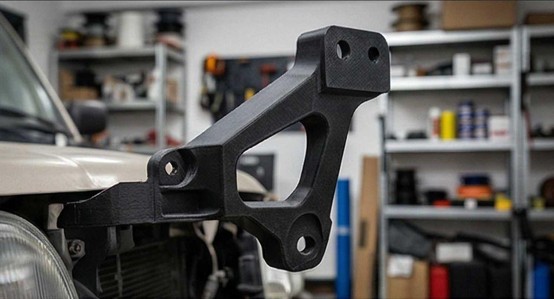
02|PETG-CF / PET-CF: A choice balancing ease of use and rigidity
PETG-CF, PET-CF = PET-based substrate + Carbon Fiber
This type of material usually has better rigidity and dimensional stability than ordinary PETG, while retaining some of the processing advantages of the PET system. PET-CF has been widely used in functional prototypes, tooling, and replacement parts applications.
Suitable for:
Functional prototypes
Tool storage
Mechanical brackets
Equipment housings
Industrial auxiliary parts
Everyday functional structural parts
If PLA-CF is more oriented towardappearance and basic functionality, then PET-CF can further expand towardfunctional parts.
03|ABS-CF / ASA-CF: For functional and outdoor environments
ABS itself has good impact resistance and heat resistance. After adding carbon fiber, rigidity and dimensional stability can be further improved.
ABS-CF is commonly used for:
Automotive prototypes
Equipment housings
Industrial structural parts
Functional prototypes
Meanwhile,ASA-CFcan further combine ASA's own good weather resistance, making it more suitable for certain outdoor functional parts. It should be noted that this type of material usually has higher printing environment requirements than PLA-CF, and an enclosed printing environment is more beneficial for reducing warping.
04|PC-CF: High strength and heat resistance direction
PC itself is an engineering plastic. After adding carbon fiber, rigidity and dimensional stability can be further improved.
Therefore, PC-CF is commonly seen in:
Industrial structural parts
High-temperature tooling
Mechanical parts
Electrical components
Functional prototypes
Compared with PLA-CF and PET-CF, PC-CF has clearly entered a more professional engineering application range.
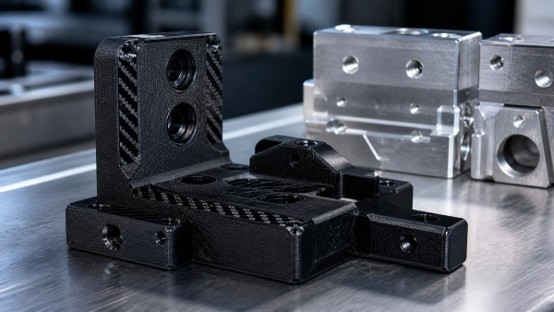
05|PA-CF: One of the most common engineering-grade carbon fiber systems
PA, also known as nylon, is a very important category in FDM engineering materials. After adding carbon fiber, the material's rigidity, strength, and dimensional stability can be improved while retaining a certain degree of nylon toughness.
Common applications of PA-CF include:
Gears
Mechanical brackets
Tooling fixtures
Robot parts
Automotive parts
Lightweight structural parts
However, one of the biggest characteristics of PA materials is that they areprone to moisture absorption.
Therefore, the use of PA-CF cannot focus only on printing temperature;drying and moisture protection are equally important. Carbon fiber itself is also abrasive, so a hardened nozzle is usually required.
06|PPA-CF: An engineering choice for higher temperature environments
PPA is a high-performance polyamide. Compared with conventional PA, it is more suitable for applications with higher temperature and dimensional stability requirements.
Therefore, PPA-CF is typically used for:
Automotive parts
Engine-adjacent structural parts
Industrial fixtures
High-temperature brackets
Robot structural parts
Electrical functional parts
This is also the material direction of ANTINSKY's newly launchedPPA-CF-HT.

07|PPS-CF: For demanding engineering environments
PPS itself is a high-performance engineering plastic with excellent heat resistance, chemical resistance, and dimensional stability.
When PPS is combined with carbon fiber, rigidity and structural stability can be further improved. Therefore, PPS-CF belongs to a category of carbon fiber FDM materials that is more oriented toward high-end engineering applications.
For example, PPS-CF can be used for:
High-temperature structural parts
Automotive parts
Industrial equipment
Electrical components
Functional parts in chemical environments
High-temperature tooling fixtures
The heat deflection temperature of some PPS-CF products can reach above 230°C, and the specific performance depends on the specific formulation and product specifications.
These materials all belong to “carbon fiber reinforced thermoplastic materials”, but they cannot simply be considered as merely arranged from low to high performance. Different substrates actually correspond to different application scenarios.
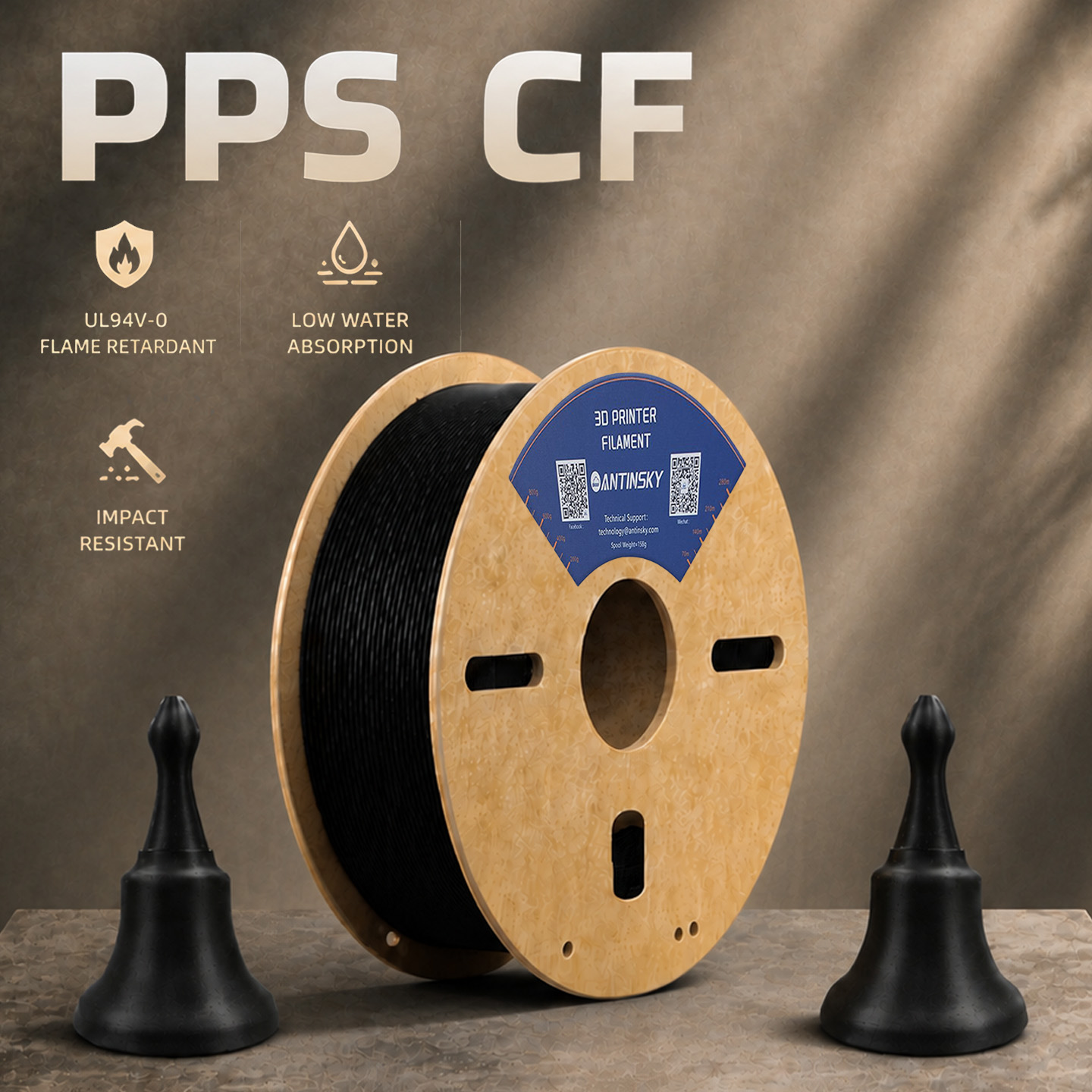
CF is not “the more, the stronger”; the substrate is the key to selection
Here there is also a very important misconception.
Many people, upon seeing the term “carbon fiber,” will think:Higher carbon fiber content → Stronger material → Definitely better.
In fact, this is not the case.
For FDM filaments, the final performance depends on:Substrate + carbon fiber type/content + material formulation + printing parameters + printing orientation
For example:
PLA-CF's advantage may be ease of printing and excellent appearance;
PA-CFis more suitable for mechanical structures;
PPA-CFis more suitable for high-temperature engineering environments;
Meanwhile,PPS-CFfurther targets applications with higher requirements for high temperature, chemical environments, and dimensional stability.
Therefore, the truly reasonable way to select is not: “I want the strongest CF material.”
Rather, it should be:“What kind of environment will my part need to face?”
From PLA-CF to PPS-CF, carbon fiber is continuously expanding the application boundaries of FDM 3D printing materials.
For ordinary creative work, PLA-CF can provide higher rigidity and a unique surface texture; for functional parts, PA-CF, PET-CF, and PC-CF can provide further engineering performance; and when applications enter high-temperature, high-load, and more demanding industrial environments, PPA-CF and PPS-CF become more noteworthy choices.
ANTINSKY PPA-CF-HT and PPS-CF-HS are new options launched along this material advancement path.
For detailed product information, please click the link below:


